> ## Documentation Index
> Fetch the complete documentation index at: https://scaffoldstacks.mintlify.site/llms.txt
> Use this file to discover all available pages before exploring further.
# Developer workflow
> Edit contracts, add features, and iterate quickly
Edit Clarity contracts, regenerate bindings, run tests, and redeploy. Requires Clarinet **3.21+**. Run `stacksdapp doctor` if you hit toolchain errors.
## Contents
* [Edit contracts](#edit-contracts)
* [Add a contract](#add-a-contract)
* [Run tests](#run-tests)
* [Type-check contracts](#type-check-contracts)
* [Redeploy after changes](#redeploy-after-changes)
* [Project structure](#project-structure)
* [Code generation](#code-generation)
* [Frontend features](#frontend-features)
* [Local development](#local-development)
## Edit contracts
Open any `.clar` file in `contracts/contracts/` and add a function:
```clarity theme={null}
(define-public (multiply (n uint))
(begin
(var-set counter (* (var-get counter) n))
(ok (var-get counter))))
```
Update bindings:
```bash theme={null}
stacksdapp generate
```
Or let `stacksdapp dev` / `stacksdapp generate --watch` handle it.
Redeploy to apply on-chain changes:
```bash theme={null}
stacksdapp deploy --network testnet
```
The `multiply` function appears in the debug UI after regeneration and redeployment.
## Add a contract
```bash theme={null}
stacksdapp add relayer
stacksdapp add token --template sip010
stacksdapp add nft --template sip009
```
Each command creates the `.clar` file, updates `Clarinet.toml`, regenerates bindings, and updates the debug UI.
See [Working with contracts](/contracts) for a full sample contract and tests.
## Run tests
```bash theme={null}
stacksdapp test
```
See [Testing](/testing) for contract and frontend test patterns.
## Type-check contracts
```bash theme={null}
stacksdapp check
```
## Redeploy after changes
Stacks contracts are immutable. Redeploying creates versioned contracts:
```bash theme={null}
stacksdapp deploy --network testnet
# counter-v2, counter-v3, ...
```
The CLI handles versioning automatically.
## Project structure
```
my-app/
├── contracts/
│ ├── Clarinet.toml
│ ├── .cache/
│ ├── settings/
│ │ ├── Devnet.toml
│ │ ├── Testnet.toml
│ │ └── Mainnet.toml
│ ├── contracts/
│ │ └── counter.clar
│ └── tests/
│ └── counter.test.ts
└── frontend/
├── .env.local
└── src/
├── app/
├── components/
│ └── WalletConnect.tsx
└── generated/
├── contracts.ts
├── hooks.ts
├── DebugContracts.tsx
└── deployments.json
```
## Code generation
See [Code generation](/code-generation) for the full pipeline, watch mode, ABI caching, and Hiro API keys.
Summary:
1. **Parse** ABIs via `initSimnet()` (cached under `contracts/.cache/`)
2. **Normalize** Clarity types to TypeScript
3. **Render** `contracts.ts`, `hooks.ts`, `DebugContracts.tsx`
4. **Write** only when content changed
## Frontend features
### Debug UI
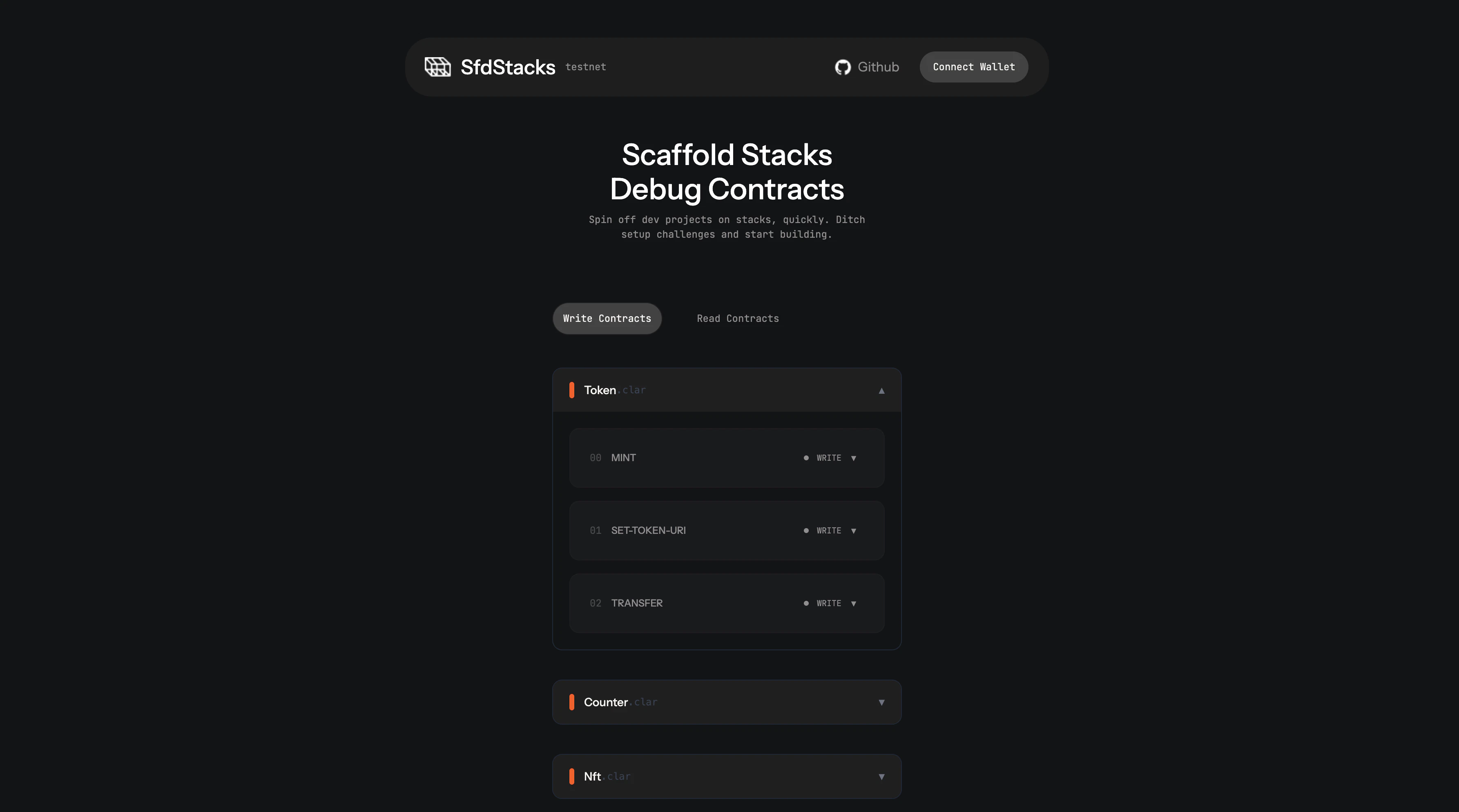
Every public function gets a typed input form. Read-only functions display results directly.
 ### Reusable hooks
```typescript theme={null}
import { useCounterIncrement } from '@/generated/hooks'
function CounterComponent() {
const { data, loading, call } = useCounterIncrement()
return (
)
}
```
### Wallet Connect
`WalletConnect.tsx` handles Leather and Xverse, including network detection.
### State management
Jotai atoms sync wallet and network state across the template.
## Local development
```bash theme={null}
stacksdapp dev --auto-deploy
```
See [Local devnet](/local-devnet) for manual deploy and devnet setup.
### Reusable hooks
```typescript theme={null}
import { useCounterIncrement } from '@/generated/hooks'
function CounterComponent() {
const { data, loading, call } = useCounterIncrement()
return (
)
}
```
### Wallet Connect
`WalletConnect.tsx` handles Leather and Xverse, including network detection.
### State management
Jotai atoms sync wallet and network state across the template.
## Local development
```bash theme={null}
stacksdapp dev --auto-deploy
```
See [Local devnet](/local-devnet) for manual deploy and devnet setup.